

Do I Really Need a Repeat Thyroid Biopsy?
One of the most common questions I hear from patients is, “If I’ve already had a thyroid biopsy, why do I need another one?”
It’s a fair question.
Most patients assume that a biopsy should provide a definitive answer. When the results come back as non-diagnostic, atypical, or indeterminate, it can be frustrating to learn that additional testing may be recommended.
The good news is that a recommendation for a repeat thyroid biopsy is usually not a sign that something terrible has happened. In fact, it is often part of a thoughtful and careful diagnostic process designed to avoid unnecessary surgery while still identifying the small percentage of nodules that may require treatment.
As a cytopathologist and Fine Needle Aspiration specialist, I spend much of my time helping patients understand these results and determining when additional testing is appropriate. In many cases, a repeat biopsy provides the information needed to move forward with confidence.
Understanding the Bethesda System for Thyroid Biopsies
When a thyroid Fine Needle Aspiration biopsy is performed, the results are typically reported using a standardized classification system called the Bethesda System for Reporting Thyroid Cytopathology.
The Bethesda system was developed to improve communication between pathologists and physicians and to help guide treatment decisions.
The Six Bethesda Categories
Thyroid biopsy results generally fall into one of six categories:
- Category I: Non-Diagnostic
- Category II: Benign
- Category III: Atypia of Undetermined Significance (AUS)
- Category IV: Follicular Neoplasm
- Category V: Suspicious for Malignancy
- Category VI: Malignant
Many patients expect their results to fall neatly into either benign or malignant categories. However, some nodules land in the middle categories where additional evaluation may be helpful.
This is where repeat biopsy and/or molecular testing often become part of the discussion.

What Is an Atypical Thyroid Biopsy Result?
One of the most misunderstood thyroid biopsy results is Bethesda Category III, commonly referred to as AUS (or previously FLUS).
These abbreviations stand for Atypia of Undetermined Significance and Follicular Lesion of Undetermined Significance.
Simply put, the cells show some atypical features, but not enough to confidently classify the nodule as benign or malignant.
Why Do AUS and FLUS Results Happen?
There are several reasons why a biopsy may fall into this category:
- Mild cellular abnormalities
- Changes related to inflammation
- Degenerative changes within the nodule
- Limited cellular material
- Features that overlap between benign and malignant conditions
An AUS result does not mean cancer is present.
Instead, it means the findings deserve closer evaluation before making major treatment decisions.

Why a Repeat FNA Often Makes Sense
When patients hear they need another biopsy, many assume something was missed the first time.
That is usually not the case.
A repeat Fine Needle Aspiration often provides additional cellular material, clarifying previously uncertain findings.
Reasons a Repeat Thyroid Biopsy May Be Recommended
A repeat biopsy may be helpful when:
- The initial result was non-diagnostic
- The sample contained limited cellular material
- The findings were categorized as AUS
- New ultrasound findings have emerged
- The nodule has changed or significantly grown over time
In many situations, the second biopsy provides a much clearer answer than the first.
Patients interested in learning more about the biopsy procedure itself can review my guide to Fine Needle Aspiration biopsy services.
Understanding How Thyroid Cancer Typically Develops
Most thyroid cancers are well differentiated, which means that they look like thyroid tissue. This also means they behave well and develop slowly.
The goal of a repeat biopsy is to gather the information necessary to make the most accurate diagnosis possible before recommending surgery or other treatments.
A careful approach often leads to better decisions and helps many patients avoid unnecessary procedures.
How Molecular Testing Fits Into Thyroid Nodule Evaluation
One of the most important advances in thyroid nodule management has been the development of molecular testing.
Molecular testing examines genetic alterations within thyroid cells to help estimate the likelihood that a nodule may be cancerous.
When Molecular Testing Is Most Helpful
Molecular testing is most commonly considered when:
- A biopsy result is categorized as AUS
- The diagnosis remains uncertain after cytologic evaluation
- Additional information could influence treatment decisions
- Patients want to avoid unnecessary surgery whenever possible
Molecular testing does not replace pathology.
Instead, it serves as an additional tool that can help physicians better understand an indeterminate thyroid nodule.
When used appropriately, molecular testing can provide valuable information that supports individualized patient care.
Why Experience Matters in Repeat Thyroid Biopsies
The quality of a biopsy depends on more than simply inserting a needle into a nodule.
Proper ultrasound guidance, accurate targeting, specimen preparation, and immediate assessment of sample adequacy all contribute to diagnostic success.
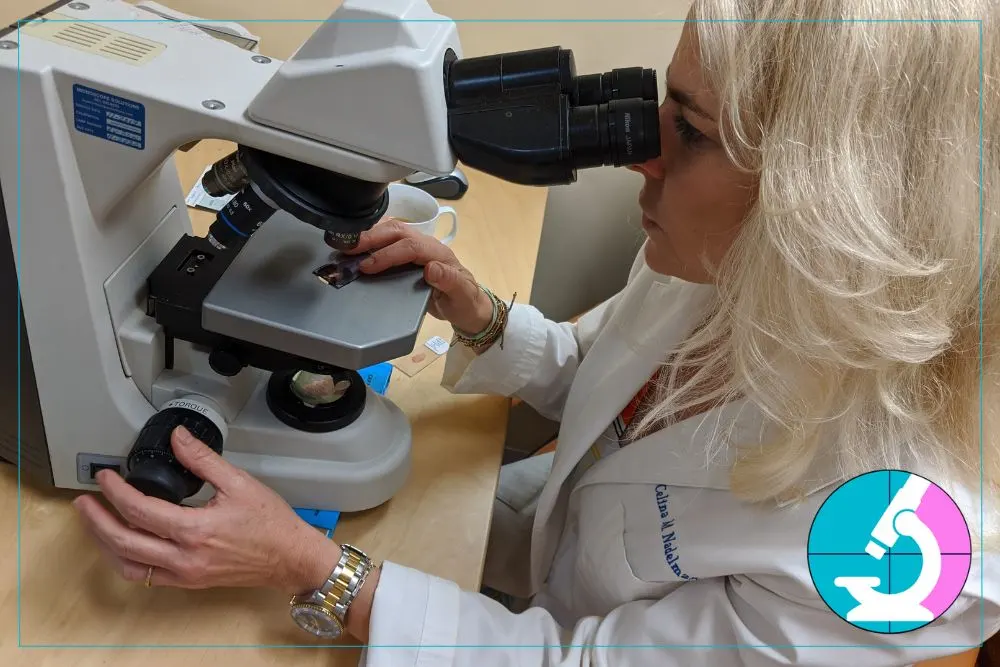
As a board-certified cytopathologist, I both perform both the biopsy and evaluate the specimen.
The Advantage of Rapid On-Site Evaluation
Rapid On-Site Evaluation, often called ROSE, allows me to assess the sample under the microscope during the procedure itself.
This helps ensure that sufficient diagnostic material has been collected before the patient leaves the office.
This results in fewer inadequate samples, fewer repeat procedures, and greater diagnostic confidence.
Patients can also learn more about why Fine Needle Aspiration remains the preferred diagnostic approach for most thyroid nodules by reading my article on thyroid core biopsy vs. Fine Needle Aspiration.
What Patients Should Remember About Repeat Thyroid Biopsies
A recommendation for a repeat thyroid biopsy is not necessarily bad news.
In many cases, it reflects a careful and thoughtful effort to obtain the most accurate diagnosis possible.
Whether the initial result was non-diagnostic, atypical, or indeterminate, additional testing often helps physicians avoid unnecessary surgery while identifying the patients who truly need treatment.
If your physician recommends a repeat biopsy, the most important thing to remember is that thyroid cancer is usually a slow-growing disease. Taking the time to gather complete and accurate information often leads to better decisions and better outcomes.
For patients who previously received an inconclusive result, I also recommend learning more about what a non-diagnostic thyroid biopsy result really means, as many repeat biopsies begin with understanding why the first sample was unable to provide a definitive answer.
As a cytopathologist and Fine Needle Aspiration specialist, my goal is always to provide patients with clear answers, minimize unnecessary procedures, and ensure that every treatment decision is based on the best possible information.
FAQs
No. Molecular testing is typically considered when additional information could help guide treatment decisions. Whether it is appropriate depends on the biopsy findings, ultrasound appearance, and overall clinical picture.
AUS and FLUS refer to Bethesda Category III findings. These results indicate that some cellular abnormalities are present, but there is not enough information to confidently classify the nodule as benign or malignant.
No. A repeat thyroid biopsy is often recommended because the original sample was non-diagnostic, atypical, or indeterminate. It does not automatically mean cancer is present.